
Best Travel Crates for Anxiety: 2026 Top Picks
Table of Contents
- Comparison Table: Best Travel Crates for Anxiety at a Glance
- How We Evaluated These Travel Crates for Anxiety
- 1. DODOPET Car Dog Crate: Best Overall Travel Crate for Anxiety
- 2. Space Dog Carrier Backpack: Best Budget Escape-Proof Option
- 3. Cat Carrier Bag: Best for Cats With Travel Anxiety
- 4. Ideal Pet Carrier Bag: Best Lightweight Budget Pick
- 5. Breathable Cat Carrier Backpack: Best Ventilated Space Capsule
- 6. Breathable Portable Cat Carrier Backpack: Best Transparent Design
- Frequently Asked Questions
Last Updated: October 2, 2026
Comparison Table: Best Travel Crates for Anxiety at a Glance
Choosing the best travel crates for anxiety comes down to matching the enclosure to your pet's stress triggers, not just picking the roomiest box. In this guide from The Minnie Store, we break down six picks by size, material, and how well each one calms a nervous traveler.

| Picks | Price | Best For | Key Feature |
|---|---|---|---|
| DODOPET Car Dog Crate | $222.93 | Medium to large dogs | Foldable tent, sizes S-XL |
| Space Dog Carrier Backpack | $30.29 | Budget escape-proof pick | EVA shell, two sizes |
| Cat Carrier Bag | $56.24 | Cats with travel anxiety | Soft Oxford body |
| Ideal Pet Carrier Bag | $18.76 | Lightweight budget pick | Breathable, easy to clean |
| Breathable Cat Carrier Backpack | $51.88 | Ventilated space capsule | PVC and Oxford build |
| Breathable Portable Cat Carrier Backpack | $37.61 | Transparent design | Clear viewing panel |
How We Evaluated These Travel Crates for Anxiety
Here's what we weighted most:

- Escape resistance: reinforced zippers with locking sliders, metal latches rather than plastic, double-stitched seams, and no gaps wider than a paw. A determined dog can pop a standard plastic side-release buckle; look for seatbelt-style or carabiner closures on high-anxiety models.
- Crash and motion safety: how the crate attaches to a vehicle. A crate that isn't secured becomes a projectile in a sudden stop. Look for models with seatbelt pass-through loops, LATCH-style anchors, or a design that fits behind a seat and against the seatback. Soft-sided crates generally offer less structural protection than rotomolded plastic or aluminum, but a secured soft crate beats an unsecured hard one every time.
- Ventilation and visibility: mesh panels or clear windows that keep air moving on all sides, not just the door. A pet that can see out in multiple directions tends to settle faster than one staring at a solid wall, but full transparency can overstimulate some cats, a mix of clear and opaque panels is often the sweet spot.
- Size range: enough options to fit small cats up to large dogs, with interior dimensions listed rather than just breed suggestions.
- Portability: foldable or lightweight designs for stress-free travel, plus a carry handle or shoulder strap that keeps the crate level while you walk.
- Material: non-toxic, chew-resistant fabrics that hold up to destructive behavior. Aluminum and rotomolded plastic resist chewing best; reinforced Oxford cloth with a rigid frame is the next tier; plain soft-sided nylon is the least resistant.
- Behavioral fit: whether the crate can be introduced gradually. A crate with a removable top or a door that opens flat gives you more options for a 30-day transition plan than a single front-loading door.

1. DODOPET Car Dog Crate: Best Overall Travel Crate for Anxiety
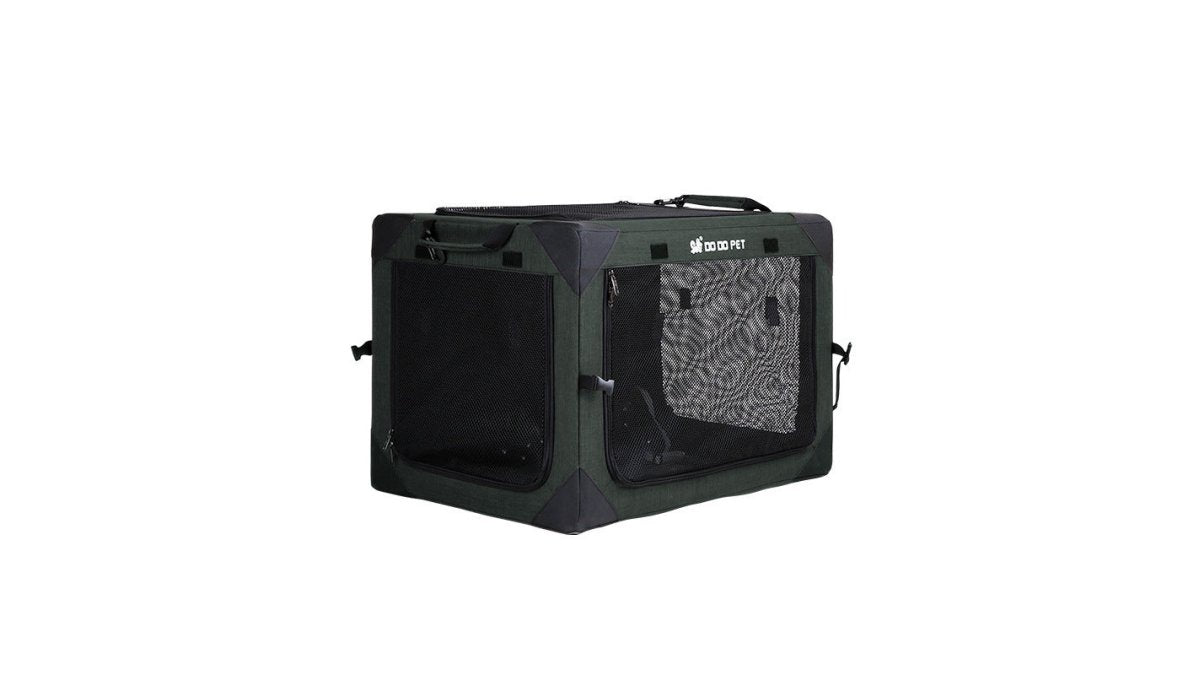
The DODOPET Car Dog Crate is our top pick because it gives medium and large dogs a den-like tent that folds flat between trips. It comes in S, M, L, and XL, so a Golden Retriever and a Corgi can each get a proper fit. The soft-sided tent shape matters for anxiety: dogs are den animals, and an enclosed space with a low ceiling and a single clear sightline tends to lower arousal more than an open wire crate where the pet can see every passing stimulus.
What makes it work for anxious travelers
- Den geometry: the sloped roof and enclosed sides block peripheral motion, which is a common trigger for dogs who panic at highway traffic or passing trucks.
- Fold-flat frame: collapses to roughly the size of a folded camp chair, so it stores in a trunk or closet without becoming a permanent piece of furniture.
- Multiple access points: most sizes include a top opening and a front door, which lets you reach in to comfort or leash your dog without unzipping the whole front panel.
- Securing points: the frame includes loops that accept a seatbelt or a tether strap. Use them. An unsecured soft crate in a sudden stop is a hazard regardless of how calm your dog is.
Where it falls short
- Chew resistance is limited. The cloth panels will not stop a determined chewer. If your dog has already destroyed a soft crate, this is not the pick for you, go with a rotomolded plastic or aluminum crate instead.
- Crash protection is minimal. Soft-sided crates absorb impact poorly compared to rigid shells. This crate is best for pets who travel calmly and for owners who secure it properly, not for pets who need maximum structural protection.
- Higher price than the backpack options, which reflects the size range and frame rather than premium materials.
How to introduce it
Set the crate up at home a week before your first trip. Feed meals inside it with the door open, then close the door for a few seconds at a time while you're in the room. By day three or four, most dogs will choose to nap in it on their own. On travel day, place a worn t-shirt or a familiar blanket inside, scent is a stronger calming cue than a new toy.
Pros and Cons
Pros:
- Four sizes cover most breeds
- Folds down fast for storage
- Lightweight for its size
- Soft-sided design feels less clinical
- Top and front access points
- Seatbelt loops for vehicle securing
Cons:
- Soft cloth won't stop a determined chewer
- Higher price than the backpack options
- Limited crash protection compared to rigid crates

2. Space Dog Carrier Backpack: Best Budget Escape-Proof Option
Budget shoppers who still want a hard shell should look here. The Space Dog Carrier Backpack uses durable EVA material that resists scratching and holds its shape, which matters for an escape-prone pet.
Pros and Cons
Pros:
- Rigid EVA shell resists scratching
- Very light at 0.68 kg
- Five color options
- Lowest price with a hard frame
Cons:
- Backpack style suits smaller dogs
- No foldable tent shape for large breeds
3. Cat Carrier Bag: Best for Cats With Travel Anxiety
Cats often panic in hard plastic boxes, and this soft-sided bag solves that. The Cat Carrier Bag is built from durable Oxford material with medium-soft firmness, which creates a cozy, secure pocket your cat can burrow into.
Pros and Cons
Pros:
- Soft body feels secure, not confining
- Lightweight at 1.53 kg
- Easy to clean Oxford fabric
- Two sizes for different cats
Cons:
- Soft sides flex under a clawing cat
- Not built for large dogs
4. Ideal Pet Carrier Bag: Best Lightweight Budget Pick
If you want the lowest-cost entry, this is it. The Ideal Pet Carrier Bag is a breathable Oxford carrier for both dogs and cats, and it cleans up easily after an accident.
Pros and Cons
Pros:
DODOPET Car Dog Crate - Foldable Pet →
- Lowest price on the list
- Breathable for short trips
- Easy to wipe clean
- Fits small dogs and cats
Cons:
- Limited to two small sizes
- Basic build, no rigid frame
5. Breathable Cat Carrier Backpack: Best Ventilated Space Capsule
Ventilation is the whole point here. This space capsule backpack uses PVC and Oxford cloth to keep air moving around your pet, and its 35x30x40 cm interior gives small dogs and cats room to settle.
Pros and Cons
Pros:
- Strong airflow for warm days
- Spacious 35x30x40 cm interior
- Light 1.13 kg frame
- Fits small dogs and cats
Cons:
- Backpack style limits large pets
- PVC panels need regular wiping
6. Breathable Portable Cat Carrier Backpack: Best Transparent Design
Some pets calm down when they can see you. This transparent backpack lets your cat watch the world, which many owners find reduces crate anxiety on short trips.
Pros and Cons
Pros:
- Clear panel keeps pet in view
- Lightest pick at 0.99 kg
- Six color choices
- Compact for vet visits
Cons:
- Clear panels offer less privacy
- Best for cats and small dogs only
Frequently Asked Questions
What features should I look for in a travel crate for anxiety?
Focus on ventilation, visibility, and secure closures. Breathable mesh panels keep air moving, while a design that lets your pet see out helps them settle. Look for reinforced zippers or latches so an escape-prone dog cannot push through. A removable, washable tray helps with accidents. Size matters too: your pet needs enough room to stand, turn, and lie down, but not so much space that they slide around during turns.
Are metal or plastic crates better for dogs with travel anxiety?
It depends on your dog. Metal crates offer strength and airflow but can rattle, which can startle some dogs. Plastic or soft-sided carriers like the DODOPET Car Dog Crate absorb sound better and feel more enclosed, which can help a nervous pet settle. For escape-prone dogs, a crate with reinforced zippers and a secure latch matters more than the material itself.
How can I help my dog feel more secure in their travel crate?
Start crate training at home, weeks before your trip. Feed meals inside the crate, add a favorite blanket, and reward calm behavior with positive reinforcement. During car rides, keep the crate level and secure so it does not slide. A seat cover or travel nest underneath adds cushioning and reduces vibration. Short practice drives build confidence before longer journeys.
What makes a crate escape-proof for anxious pets?
Escape-proof dog crates for travel use reinforced zippers, metal buckles, and tight seams that resist chewing and pushing. Look for double-door access with locking mechanisms, since a single weak point is where most pets break out. Heavy-duty cloth or Oxford material holds up better than thin fabric. Always test the closures yourself before trusting them on the road.
Is it safe to leave an anxious dog in a crate during long car rides?
Yes, with preparation. Secure the crate so it cannot slide or tip, and stop every two to three hours for water, bathroom breaks, and a stretch. Never leave a pet alone in a parked car, since temperatures rise quickly. If your dog shows significant discomfort, consult your veterinarian about a behavioral plan before attempting long trips. Practice runs help you judge how your dog handles extended travel.
Traveling with a nervous pet is stressful, and the wrong carrier makes it worse. The Minnie Store stocks foldable tents, hard-shell backpacks, and soft carriers built around safety and comfort, so you can match the crate to your pet instead of guessing. Browse the collection and find the fit that turns every trip into a calmer ride.